Animal Fodder & Cheese › Cheese Cultivation
Greenfield's minimum Industrial Complex houses a hydroponic forage plant, a milk processing plant, and a cheese ripening chamber in one facility — giving small and mid-size dairy farms a way to stop selling milk at commodity prices and start selling a finished, higher-value product instead.
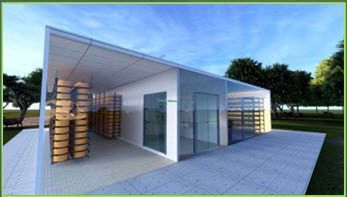
The Complex: Fodder, Cheese & Maturation
The Problem
Small U.S. dairy farms face competition from larger operations, persistently low milk prices, generational succession challenges, and difficulty accessing markets — even as consumer demand shifts toward organic, local and artisanal dairy. Feed alone accounts for roughly 37% of total livestock farm expenses, and cattle remain the largest single agricultural source of methane, with a single cow belching around 220 pounds of it per year.
The Solution
Instead of selling raw milk at a low, volatile price, the Complex lets a farm grow its own feed, process its own milk into cheese, and mature that cheese on-site — capturing the value that would otherwise go to a separate feed supplier, processor and aging facility.
Producing one ton of forage in an open field takes roughly 71,300 gallons of water; producing one ton of hydroponic fodder takes about 145 gallons. Ruminant cattle release 106 grams less carbon dioxide per day on hydroponic forage — about 1 cubic meter less methane per cow, per year — while feeding cost typically drops by about a third and milk production and quality tend to improve.
Three Components, One Facility
01 · Fodder
A fresh green forage system producing 1 to 30 tons of feed per day, improving the volume and quality of milk that goes into your cheese. Turnkey, 100% autonomous single-container units need only a level platform, water and an electrical connection — no building or climate control required. Scalable from 60 kg to 800 kg of forage per day, mobile, and requiring no permanent base.
02 · Cheese
Processing capacity of 264 to 2,640 gallons of milk per day — up to 6,000 liters — yielding roughly 1,200 to 12,000 pounds of cheese daily depending on the variety. The same platform also produces yogurt and smoothies, and is designed to be usable without prior dairy-processing experience.
03 · Maturation
Specific temperatures for each cheese varietal, controlled humidity, and permanent aeration — with the entire cellar monitored and controlled from an app.
Why It Pencils Out
Cost
Growing your own forage and processing your own milk on-site cuts out transportation costs, rented processing space, and outside labor.
Revenue
Selling cheese, yogurt and smoothies — instead of raw milk alone — reduces a farm's dependence on commodity milk pricing.
Market
Cereal grain germination can follow the U.S. organic program using OMRI-certified inputs, meeting rising consumer demand for organic dairy.
Who This Is For
Feed is the single largest expense category for U.S. livestock farms, at roughly $81 billion a year — 37% of total farm expenses. The Complex is built to fit operations across the herd-size spectrum: from roughly 36,000 U.S. dairy farms, to the country's 2.5 million goats and 5.2 million sheep and lambs, all facing the same rising feed and water costs.
Send your herd size and current dairy setup for a complimentary proposal.